NQ and ES Correlation: One Bet, Not Diversification
ES and NQ are about 93% the same trade. We measured their daily-return correlation at 0.927 across 4,471 sessions, and here is the part that matters: the correlation gets higher when markets get stressed, not lower. So holding both is not diversification. It is one bet, doubled.
If you want this NQ edge, trade NQ and size it properly. Do not tell yourself an ES leg makes the book safer. The day you need the hedge most is the day the two move closest to lockstep.
That is the whole answer. The rest is the data behind it, measured from our own NQ and ES price history, plus what happened when we ran our exact NQ book on ES instead.
Whose trades are these (read this first)
You arrived here cold, so here is who is talking before any number means anything.
The book figures below come from our own portfolio: six systematic NQ strategies run as one single-position book. TradingView backtests, 2011 to 2026, one to three contracts scaled by volatility, commissions and slippage included, $1,000,906 net on one mini contract. The style is momentum and trend continuation, intraday plus one overnight model. Not mean reversion. Not scalping.
The correlation numbers are different and simpler. They are just price. Close-to-close daily returns on NQ and ES, measured from raw 15-minute data. They do not depend on our strategy at all. Anyone with the same price history would get the same correlation.
So here is the honest split for a discretionary trader. The method transfers cleanly: measure the rolling correlation of whatever pair you are thinking of trading together, and check what it does when volatility spikes. The exact numbers are ours, for NQ and ES, over our window. They are not a universal market rule. If you trade a different pair, run it on your own data. The lesson holds; the digits will be yours.
What correlation means here, in one line
Correlation is a single number from -1 to +1 that says how tightly two things move together. At +1 they move in perfect step. At 0 they have no relationship. At -1 one zigs every time the other zags.
A real hedge wants a number near 0 or below. That is what spreads risk. At 0.93, NQ and ES are not a hedge for each other. They are two copies of the same move, with NQ as the louder one. Put another way, they share about 86% of their day-to-day variance, so the "93% the same trade" line is a fair plain-English read, not an overstatement.
NQ and ES correlation: 0.93 over 15 years
We measured the daily-return correlation between NQ and ES at 0.927 across 4,471 sessions, January 2011 through May 2025. Over the most recent 12 months in our data it was even tighter, about 0.97.
Two contracts that move together 93% of the time are not two bets. They are one bet you are paying for twice. That is fine if you know it. It is dangerous if you call it diversification and size up because you think you are spreading risk.
The point of holding two instruments is supposed to be that when one is having a bad day, the other might not be. At 0.93, when NQ has a bad day, ES almost always has a bad day too. You did not spread the risk. You bought more of it.
The trap: the correlation rises exactly when you need it to fall
Here is the part almost nobody checks. A 15-year average correlation hides how the number behaves in different weather. So we split every session into three buckets by how volatile the market was, then measured the correlation inside the calmest third and the wildest third.
It moves the wrong way.
| Market condition | NQ-ES correlation |
|---|---|
| Calmest third of sessions | 0.89 |
| Wildest third of sessions | 0.94 |
In calm markets the two drift apart a little. In wild markets they lock together. The correlation rises with volatility. That is the opposite of what you would want from a hedge, because a sell-off is exactly when you would want the second leg to be doing something different. Instead it does the same thing, harder.
This is not a quirk of how we sliced the data. The annual numbers tell the same story without any bucketing at all.
The binning-free proof: calm years and crisis years
If correlation really tightens under stress, then the calmest year on record should show the lowest correlation, and a crisis year should show one of the highest. That is exactly what happened.
| Year | NQ-ES correlation | Note |
|---|---|---|
| 2011 | 0.94 | |
| 2012 | 0.92 | |
| 2013 | 0.89 | |
| 2014 | 0.91 | |
| 2015 | 0.94 | |
| 2016 | 0.92 | |
| 2017 | 0.79 | calmest year, lowest correlation |
| 2018 | 0.94 | |
| 2019 | 0.95 | |
| 2020 | 0.92 | |
| 2021 | 0.86 | |
| 2022 | 0.97 | bear market, one of the highest |
| 2023 | 0.92 | |
| 2024 | 0.94 | |
| 2025 (to May) | 0.98 |
The calmest year on record, 2017, had the lowest annual correlation at 0.79. The 2022 bear market had one of the highest at 0.97. The correlation never broke below 0.79 in 15 years, and it climbed toward 1.0 precisely in the years that hurt.
That is the binding proof, and it needs no buckets. When the market was calm, the two indices had a little room between them. When the market fell apart, they moved as one.
The 15-year picture: rolling correlation, calm to crisis
Annual numbers are clean but coarse. To see the live behavior, we computed the correlation over a trailing 60-session window and rolled it across the whole 15 years.
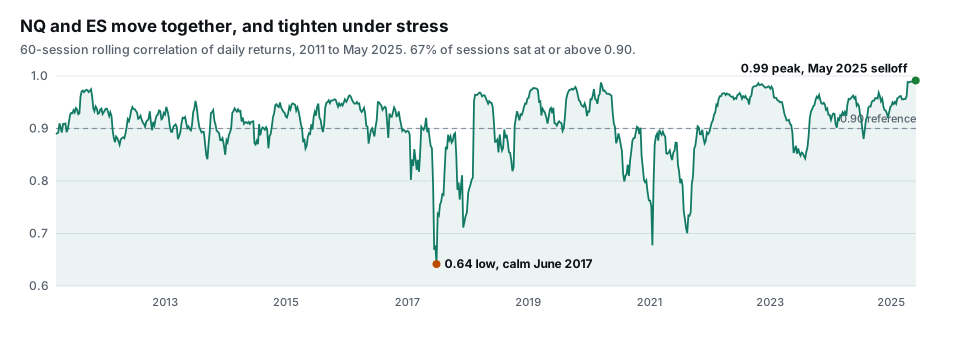
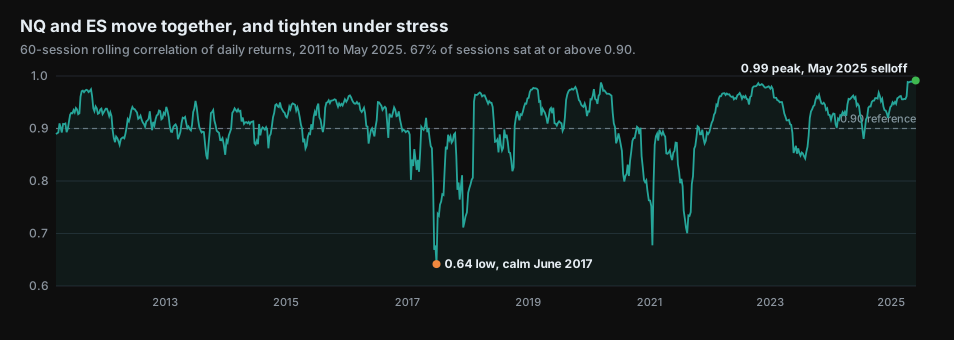
The rolling number hit its 15-year low of 0.64 in late June 2017, the calmest stretch in the data. It hit its high of 0.99 in the May 2025 selloff. And 67% of all sessions sat at or above 0.90.
Read the shape, not just the dots. The line spends most of its life high, sags only in the quietest periods, and snaps back toward 1.0 whenever the market gets nervous. The diversification you think you are buying shows up only when you do not need it, and vanishes the moment you do.
The diversification kicker: our exact book, run on ES
There is a second way people try to get diversification out of these two markets. Not just holding both, but running a strategy on both. The thinking goes: if my NQ system works, an ES copy of it should add a second, lightly correlated return stream.
We tested that directly, because we could. We took the exact six-strategy book, the same deployed Pine code that produces our NQ signals, and ran it on ES in TradingView instead of NQ. Same logic, same rules, same period. Only the instrument changed.
The ES version produced 5,383 trades and made $122,662, against the NQ book's roughly $1,000,906. About one-eighth of the money. And it failed every test we use to decide whether an edge is real.
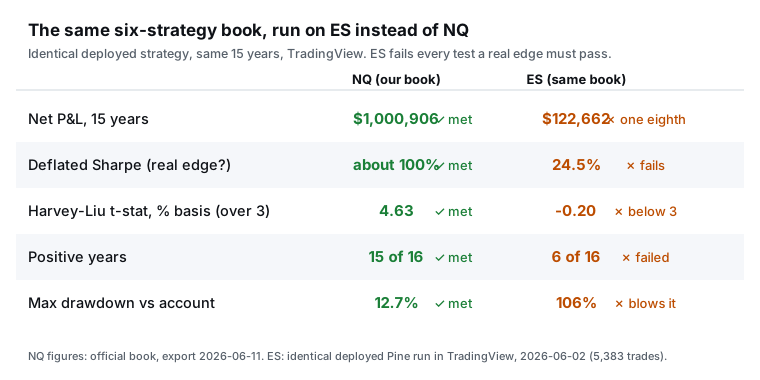
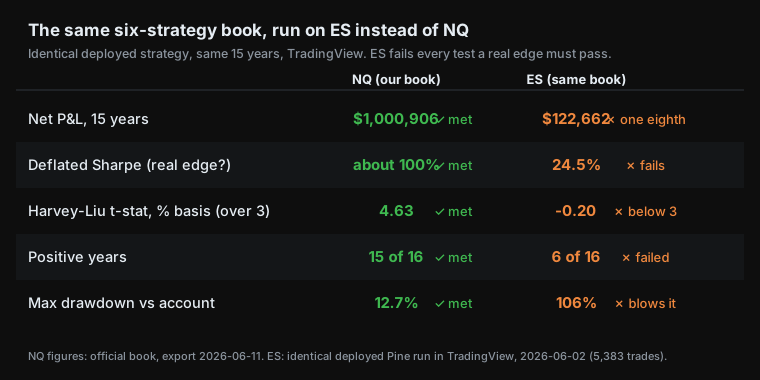
The Deflated Sharpe, which docks an edge for luck and for how many variations we tried, came in at about 24.5% on ES versus roughly 100% on NQ. The Harvey-Liu t-statistic, which has to clear 3.0 for an edge to count as real, was -0.20 on ES on the same percent-return basis that gives NQ its 4.63. That is essentially zero. The ES version made money in only 6 of 16 years. Its worst drawdown was 106% of the account, meaning a trader running it at that size would have been wiped out. It spent about 10 years underwater.
Be careful what you take from this. This is a measured run on our exact deployed Pine code, exported from TradingView on June 2, 2026. It is not a recommendation, and it is not us saying ES is a bad market. ES is a fine market. What it shows is narrower and more useful: our specific NQ edge does not transfer to ES. The structure that makes our book work, the way NQ opens and trends, is an NQ property. Bolt an ES copy onto the book and you do not get a second engine. You get a worse one that fails on its own and adds almost nothing as a hedge, because it is 93% correlated with the NQ leg anyway.
So both routes to "diversify with ES" dead-end. Hold both at full size and you have doubled down on one bet. Run the strategy on both and the ES copy does not work and does not diversify. The same pattern holds across the other index futures, where only NQ cleared our edge tests, in our NQ system tested on every index.
Where does this leave the trader who wants the NQ edge
Trade NQ. Size it like the single, concentrated bet it is, because that is what it is. Adding ES does not cut the risk. It funds more of the same risk with a contract whose edge, for this style, is not there.
If your account cannot carry one NQ through a real drawdown, the answer is not a second instrument. It is a smaller version of the same one. The micro, MNQ, is exactly one tenth of NQ, so it carries one tenth the dollar risk on the identical trade. That is how you size down without pretending two correlated legs are a hedge.
The basic split between the two contracts, range, point value, margin, and which to actually trade, lives in our flagship comparison, NQ vs ES futures: which to trade and how to size it. For why NQ swings so much more in dollars and how to size targets to it, see NQ and ES average daily range. And for why this edge concentrates so heavily in a couple of hours, which is part of why it is an NQ property and not a market-wide one, see the best time to trade NQ futures. You can see how the whole six-strategy book is built on our strategies page.
NQ and ES correlate 0.93, and the correlation rises toward 1.0 exactly when markets are stressed. Holding both is one bet doubled, not diversification. If you want this NQ edge, trade NQ and size it properly. To risk less, trade a smaller NQ (the MNQ micro), not a second correlated contract.
How we measured this, and where it stops
The correlation work uses our own intraday price history: 15-minute NQ and ES bars from the A2API dataset, January 3, 2011 through May 30, 2025, which is 4,471 aligned sessions. We took the close-to-close daily return for each instrument, where the daily close is the last 15-minute bar of each ET calendar date, then computed the Pearson correlation of the two return series. Volatility buckets use a trailing 20-session standard deviation of NQ returns, split into thirds; we measured the correlation inside the calmest and wildest thirds. The rolling figure is the same Pearson correlation over a trailing 60-session window.
The book P&L runs on a different and longer window. Those figures (the $1,000,906 NQ net, the 15-of-16 positive years, the 12.7% drawdown) are TradingView backtests from June 2011 through June 2026, on one mini contract. The same-book-on-ES run was exported June 2, 2026. So two windows are in play and we keep them apart: price-correlation data ends May 30, 2025, while book performance runs into 2026. We never blur the two.
The two edge tests on the ES run come straight from our standard scripts, the same ones we run before any strategy enters the book. The tear sheet script gives the t-statistic on a per-trade percent-return basis, the scale-stable Harvey-Liu number we lock for NQ, so NQ's 4.63 and ES's -0.20 sit on the same ruler. A separate Deflated Sharpe script recomputes the edge test independently (Bailey and Lopez de Prado), and it puts NQ near 100% and ES at 24.5%. Both tests fail ES well short of the bar.
What would falsify the thesis. If the rolling correlation fell toward zero in stressed periods instead of rising toward one, the diversification case would be live. It does the opposite. If the same strategy on ES had passed our legitimacy tests and run uncorrelated to the NQ leg, an ES sleeve would add something. It failed and it is 0.93 correlated. Show us a sustained, repeatable stretch where NQ falls hard while ES holds, and we will update this. Fifteen years of data does not contain one.
One limit, said plainly. Correlation is backward-looking. It describes what these two markets have done, not a law that binds them forever. A future regime could pull them apart. But the burden of proof runs the other way: 67% of sessions above 0.90, and the tightest readings landing in every crisis, is a heavy thing to bet against. The honest planning assumption is that in the next sell-off, NQ and ES move together, because that is what they have always done.
If you would rather trade the NQ edge systematically than guess at sizing it, that is what we sell. The same six systems measured here send their entries as real-time signals. The full performance, drawdowns and all, is on the 15-year tear sheet, and the plans are on the pricing page.
Correlation figures are measured from our NQ and ES price data, 2011 through May 2025. Strategy results are backtested at one contract, 2011 to June 2026; the same-book-on-ES run was exported June 2, 2026. These are hypothetical performance results; hypothetical results have inherent limitations and do not represent actual trading, and no representation is made that any account will achieve similar results. Disclosure: we trade this NQ system live and sell access to the signals; judge the data accordingly.
Hypothetical performance disclaimer (CFTC Rule 4.41): hypothetical or simulated performance results have certain limitations. Unlike an actual performance record, simulated results do not represent actual trading. Also, since the trades have not been executed, the results may have under- or over-compensated for the impact, if any, of certain market factors, such as lack of liquidity. Simulated trading programs in general are also subject to the fact that they are designed with the benefit of hindsight. No representation is being made that any account will or is likely to achieve profit or losses similar to those shown. Past performance does not indicate future results. Futures trading involves substantial risk of loss and is not suitable for all investors. This is educational content, not investment advice.