NQ vs ES Futures: Which One Should You Trade?
Trade NQ if you want bigger dollar moves. It averages $2,750 of daily range per contract. ES averages $1,815. Trade ES if you want a calmer ride. And start with the micros (MNQ or MES) if you are new or under $25k.
One warning before you trade both: we measured the NQ-ES correlation at 0.93, and it gets worse when markets get wild. So trading the pair is not diversification.
That is the whole answer. Everything below is the data behind it. We measured it from our own NQ and ES price history, 2011 through May 2025. Not a spec sheet.
NQ vs ES at a glance
| ES (S&P 500) | NQ (Nasdaq-100) | |
|---|---|---|
| Point value | $50 | $20 |
| Tick size / value | 0.25 = $12.50 | 0.25 = $5.00 |
| Micro version | MES, $5 / point | MNQ, $2 / point |
| Underlying | 500 large US stocks | 100 biggest names, tech heavy |
| Typical daily range | ~$1,815 | ~$2,750 |
ES is worth more per point. NQ moves far more points. Here is how that works out in dollars, the only unit that matters.
NQ vs ES daily range: 3.8x wilder in points, only 1.5x in dollars
We measured the average full-session range on both contracts, in points and in dollars.
| Period | NQ pts | NQ $/contract | ES pts | ES $/contract |
|---|---|---|---|---|
| Full (2011 to May 2025) | 137 | $2,750 | 36 | $1,815 |
| Last 12 months | 359 | $7,186 | 75 | $3,735 |
| 2022 (high vol) | 335 | $6,690 | 81 | $4,044 |
| 2020 (high vol) | 239 | $4,780 | 64 | $3,203 |
| 2017 (calm) | 48 | $966 | 14 | $700 |
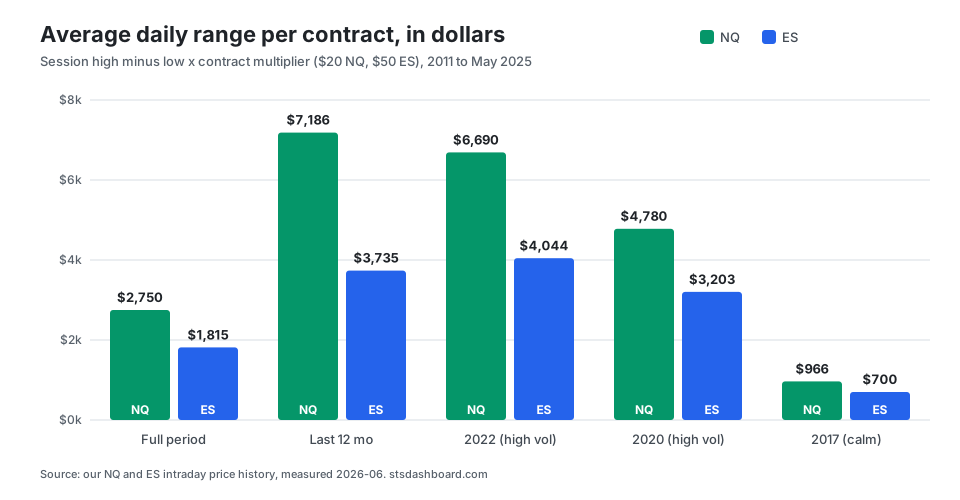
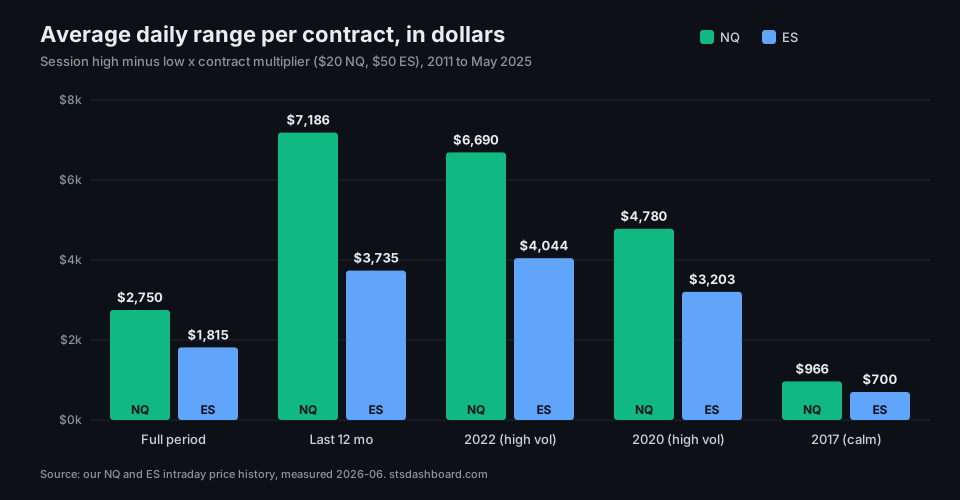
Two things most comparisons miss:
- NQ is 3.8x wilder than ES in points, but only 1.5x in dollars ($2,750 vs $1,815). Why? Each ES point is worth $50. Each NQ point is worth $20. Trade the dollars, not the points.
- Range is not fixed. Calm 2017 ran NQ at $966 a day. Wild 2022 ran it at $6,690, seven times more. Size for today, but plan for it to triple in a stressed market.
Size from the dollar, never the point
Say you risk $500 per trade. Here is your stop on each contract:
- NQ: $500 / $20 per point = 25 points
- ES: $500 / $50 per point = 10 points
- MNQ: $500 / $2 per point = 250 points
- MES: $500 / $5 per point = 100 points
Same risk, very different stops. If you switch contracts but keep the same point stop, you just changed your risk by 2.5x without noticing. Always size from the dollar, never the point.
NQ vs ES correlation: 0.93, and worse when it counts
We measured the daily-return correlation between NQ and ES at 0.927 across 4,471 sessions, and 0.966 over the last 12 months. They move together nearly every day.
Here is the part almost nobody talks about. The correlation rises to 0.94 when volatility is high and falls to 0.86 when it is calm. So the two contracts protect each other the least in a sell-off, which is exactly when you would want it most.
Trading NQ and ES at full size is not diversification. It is the same bet twice, with NQ as the louder version. Size them as one combined position.
Watch both if you like. Use ES to read the broad market. Use NQ as the louder version of it.
When NQ actually pays (you only learn this by trading it)
A spec sheet will never tell you this. First, whose trades these are. The numbers below come from our own book of six systematic NQ strategies. We run them as one single-position portfolio in TradingView backtests, 2011 to 2026, at 1 to 3 contracts scaled by volatility. The style is momentum and trend continuation (intraday plus one overnight model), not mean reversion. So these numbers show how that kind of system experiences NQ. If you trade discretionary or mean-revert, the method of measuring your own profit by hour still works. Our exact percentages do not transfer.
Across 15 years and 5,424 of our NQ trades, 58% of all the profit came from trades entered in the 9 ET hour (the 9:30 cash open). Trades entered between 9 and noon ET made 70%. The rest of the day barely matters.
The kicker: that most profitable hour has our lowest win rate, 35%. The NQ edge is not being right often. It is catching a few big opening-range breakouts and letting them run. If you trade NQ, your day is mostly made or missed in the first 90 minutes. We built our NQ strategies around exactly that.
NQ vs ES margin: the account matters more than the margin
Intraday margin is set by your broker, and it rises with volatility. But the order holds: NQ needs more than ES, and the micros need a fraction of either. The margin to enter is not what protects you. The account behind the contract is. In a wild year NQ can swing more than $6,000 in a single day. So treat a five-figure account as the floor for one mini. Micros work on a few thousand.
At one contract, an NQ round turn costs about $14 all in. That is a rounding error against NQ's $2,750 average daily range. Real, but not the deciding factor.
Which contract is right for you
- Account under $25k, or still learning: MNQ. Same market, a tenth of the dollar risk.
- You want maximum movement and can stomach $5k-plus daily swings: NQ.
- You want a calmer ride and broad-market exposure: ES, or MES to start.
- You trade a tested system: trade the contract it was built and validated on. Ours was built on NQ on purpose. See the full 15-year tear sheet.
How we measured this, and where the numbers stop helping
Ranges are the average session high minus low, in points. We convert points to dollars at the contract multipliers ($20 per NQ point, $50 per ES point). Correlation is computed on daily returns. The measurement window is 2011 through May 2025. The strategy figures above come from TradingView backtests at one contract, 2011 to June 2026.
Two limits worth saying plainly. Daily range measures opportunity, not profit. No trader captures the full bar, and a wide range cuts both ways when you are on the wrong side of it. Also, the 58% profit figure describes our own strategy's trades, not NQ itself. A different system on the same contract will concentrate its profit differently, or not at all.
Trade NQ with a tested system
We run a rules-based NQ portfolio, backtested across 15 years and 5,424 trades: +1,000.9% return, 1.59 Sharpe, profitable 15 of 16 years. The full performance tear sheet is published openly. The edge leans on exactly what makes NQ NQ: the range and the opening volatility shown above. See how the book is built in our six NQ strategies, or see the live signals and pricing.
Range and correlation figures are measured from our NQ and ES price data, 2011 through May 2025. Strategy results are backtested at 1 contract, 2011 to June 2026. These are hypothetical performance results; hypothetical results have inherent limitations and do not represent actual trading, and no representation is made that any account will achieve similar results. Past performance does not indicate future results. Disclosure: we trade this NQ system live and sell access to the signals; judge the data accordingly. Futures trading involves substantial risk of loss and is not suitable for all investors. This is educational content, not investment advice.