NQ and ES Average Daily Range, and How to Use It
Over the last 15 years, one NQ contract moved about $2,750 from its daily high to its daily low, on average. One ES contract moved about $1,815. That is the average daily range, and it is the most useful number most traders never write down.
But the average hides the real story. In a calm year like 2017, NQ's daily range was only $966. In a wild year like 2022, it was $6,690. That is about seven times wider, same contract, same exchange. If your target and stop are built for one of those days and the market hands you the other, your plan is already wrong before you click.
This article is about using that number, not just knowing it: how to size a realistic target, set a stop that fits the day, and judge whether a day is calm or wild before you trade it.
The 15-year average is your baseline, not your plan
Average daily range, often shortened to ADR, is simple. Take the high of the session, subtract the low, and you get the range in points. That is the widest the day got, high to low, so it is a ceiling, not what one trade can capture. Multiply by the point value and you get it in dollars. NQ is $20 per point. Average those daily ranges over a stretch of time and you have the ADR.
One quick comparison if you came here to weigh the two. In dollars, NQ's average day runs about 1.5 times ES's ($2,750 versus $1,815), and ES expands in wild years too, just less. The full side-by-side lives in our NQ versus ES piece. From here this article stays on NQ, the contract we trade.
Here is NQ's range from the calmest year on record to the wildest, measured from 2011 through May 2025. We pulled the calmest year, the wildest, a couple in between, and the full-period average, so you see the whole spread, not a flattering slice.
| Period | NQ points | NQ $/contract |
|---|---|---|
| 2017 (calmest) | 48 | $966 |
| 2019 (calm-ish) | 98 | $1,960 |
| Full period (2011 to May 2025) | 137 | $2,750 |
| 2020 (covid year) | 239 | $4,780 |
| 2022 (bear market) | 335 | $6,690 |
| Last 12 mo (to May 2025) | 359 | $7,186 |
Micro contracts are one tenth of these dollar figures. MNQ is $2 per point, so its average day is about $275.
The full-period average is a blend of very different worlds. Treat it as a starting point, then adjust for the day in front of you.
Whose trades are these
Before we turn range into rules, here is who is talking, because the framing matters.
The book numbers in this article (the $943 average loss we use below, the 5,424 trades) come from our live system. It is six systematic NQ strategies run as one book that holds one position at a time, backtested in TradingView from 2011 to 2026 at one to three contracts. The style is momentum and trend-continuation: it buys strength and holds the move, mostly intraday with one overnight piece. It is not mean reversion (fading moves back to an average) and not scalping (many tiny trades).
The range numbers themselves are different and simpler. They are just price. Session high minus low on NQ and ES, measured from raw 15-minute data. They do not depend on our strategy at all. Anyone with the same price history would get the same range.
So here is the honest split for a discretionary trader. The method in this article transfers cleanly: measure the range, size your target and stop against it, and re-check it when volatility shifts. The exact dollar figures from our book ($943, and so on) are ours, not a universal market rule. Your average loss is your own. Use our number as an example of the math, then run it on yours.
The same contract swings about seven times wider in a wild year
Look at the spread in the table again, but as a picture. The chart below shows NQ's average daily range from the calmest year on record to the wildest, with each bar labeled as a multiple of that calm 2017 baseline.
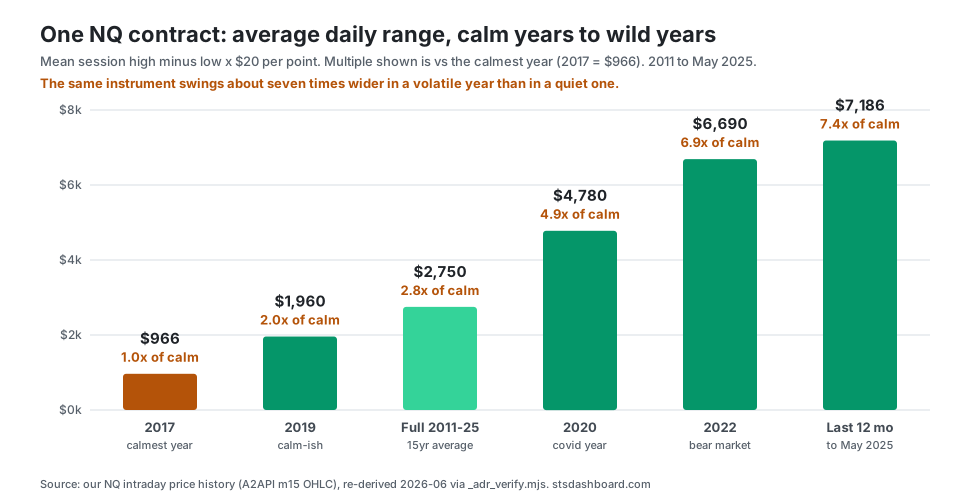
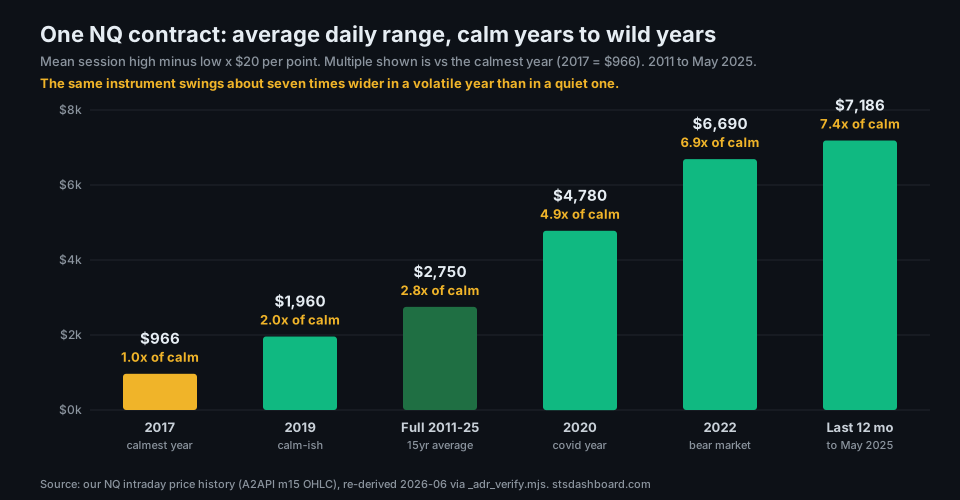
This is the part most range guides skip. Volatility does not nudge the range. It multiplies it. The 15-year average of $2,750 is only about 2.8 times the calm baseline. The wild years sit far above the average, not a little above it.
ES does the same thing, just less violently. When the market gets nervous, range explodes, and it does so fast.
The practical lesson writes itself. Plan for the multiple, not the average. Size a target and stop for a $2,750 day while the market delivers $6,000+ days, and your targets get hit early while your stops get run on noise. The reverse is just as bad. A target built for a wild day sits unfilled all session on a quiet one.
Turning range into a target you can actually hit
Here is the first concrete use. Average daily range tells you the realistic ceiling on how far price can travel in a day. Ask for more than the day usually gives, and a winner turns into a loser.
A single intraday move rarely captures the full range, because price pulls back and chops along the way. So traders often aim for something like a third to a half of the recent daily range in one trade, not the whole thing. That is a rough convention, not a hard number, but it keeps your target inside what the day can plausibly deliver.
Run the math on a calm NQ day. If the average range is about $1,000 on the quiet end, a target asking for $1,500 of favorable movement is asking the market to do half-again its normal day in your direction, in one trade. That is a low-odds ask. On a wild $6,000 day, that same $1,500 target is modest and may leave money on the table.
Same dollar target. Opposite verdict. The only thing that changed was the day's range. That is why a fixed profit target quietly fights you: too greedy when the market is asleep, too timid when it is moving.
Range is also how you judge a stop
The second use is the one that protects the account. A stop has to survive the day's normal noise, or it will fire on a wiggle that means nothing.
We like to look at range as a multiple of risk. The last chart measured range against a calm baseline. This one measures it against money at risk, our book's $943 average losing trade. The question is simple: how many of those $943 stops does a day's range actually hold?
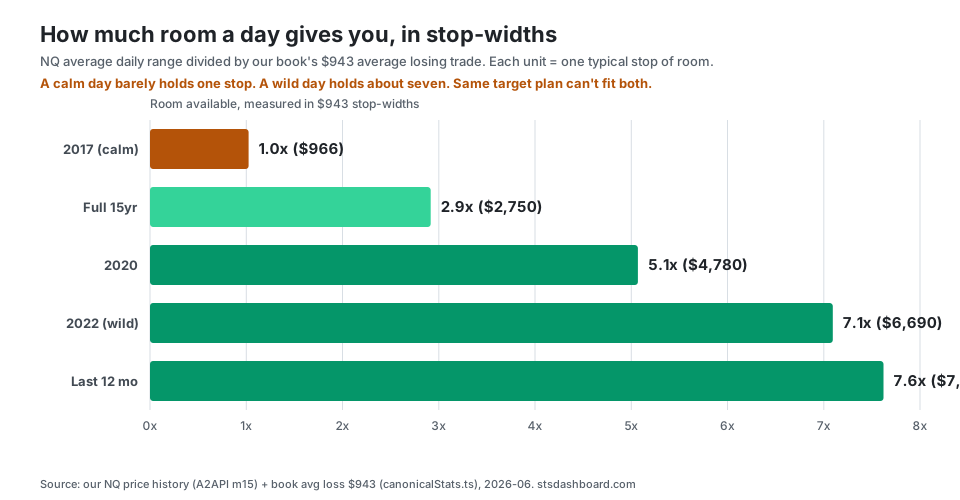
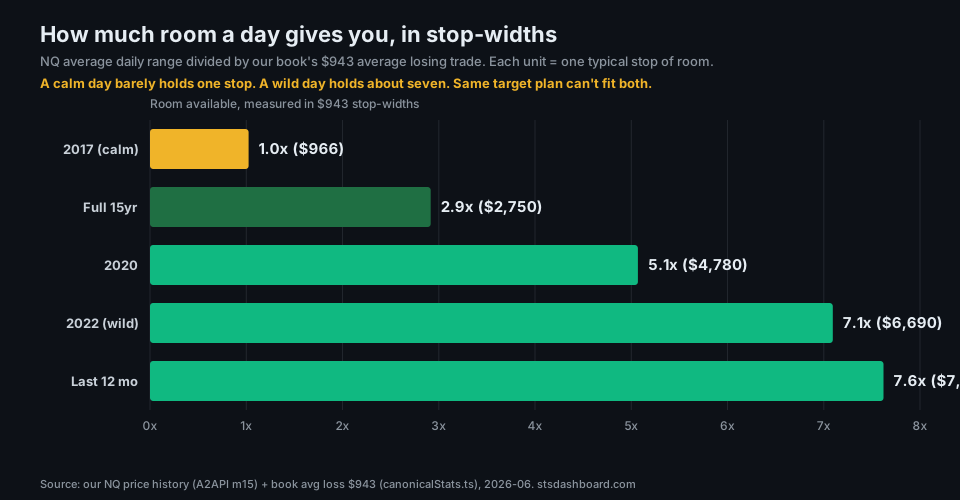
On a calm day the whole range is barely wider than one typical stop, so there is almost no room to give. On a wild day the range holds about seven, so price can swing through your level and back without the move meaning anything.
This is exactly why a fixed-point stop, the same number of points every day, breaks down. We tested this directly on all 5,424 of our trades, and fixed point stops destroyed profit largely because NQ's price rose more than tenfold over the window, so a fixed width kept shrinking in relative terms. The full result is in our piece on how many points an NQ stop should be. The short version: a stop should scale with the day's range, not sit at a constant number.
So the better question is not "how many points should my stop be." It is "how much room does today have, and what fraction of it can I risk." A stop set at a slice of the current daily range survives normal noise. As a frame, that slice sits well under one full day's range, and the calmer the day the smaller it should be, since a calm day barely holds one typical stop to begin with. A fixed-number stop gets run on wild days and barely breathes on calm ones.
Stop using the 15-year average as a fixed plan. Measure the recent daily range first, size your target at a slice of it, and set your stop as a fraction of it. The same dollar figure can be reckless on a calm day and timid on a wild one. The day's range is what tells you which.
How to read the day before you trade it
You do not need a model to know which world you are in. A few cheap checks tell you whether today is closer to the $1,000 day or the $6,000 day.
Look at the last week or two of daily ranges, not the 15-year average. Volatility clusters: calm follows calm and wild follows wild for a while, so recent range is the best simple guess for the next day. If the last five sessions each ran $4,000+, the average is stale and the day is wild. Plan for the wild number.
Watch the overnight session. NQ trades nearly around the clock, so it moves before the regular 9:30 a.m. ET open. A large overnight swing before that open is an early flag that range will be big. A flat, quiet overnight often leads to a tighter day.
Check the obvious calendar. Big economic releases and Federal Reserve days tend to widen range. We are not making a call on any specific day here. The point is only that range is not random, and a few quick looks tell you which world you are in.
Again, our $2,750 and $943 are ours. The habit is what transfers: measure the recent range on your own instrument, size to it, and re-check it when volatility shifts.
How we measured this
The range figures come from our own intraday price history for NQ and ES: 15-minute bars from June 2010 through May 30, 2025, the A2API dataset. For each calendar day we took the session high minus the session low, in points, then multiplied by the point value ($20 for NQ, $50 for ES) to get dollars. The full-period figure averages those daily ranges from January 2011 through May 2025, about 4,470 sessions per contract. The yearly figures average the days inside each calendar year. We re-derived every number fresh from the raw bars for this article, and it matched to the dollar.
A few honest limits. Our price data ends May 30, 2025, so the "last 12 months" row means mid-2024 to mid-2025, which is why the table labels it that way. Range is backward-looking. It describes what the market has been doing, not what it will do next, and a quiet stretch can turn wild in a single session.
The one number here that is not pure price is the $943 average loss. That figure comes from our live book's TradingView backtest (2011 to 2026, single-position, one to three contracts), run with our standard commission and slippage model, the same cost basis behind every figure on our tear sheet. It is hypothetical, backtested performance, and we use it here only as a worked example of the stop-to-range math, not as a number you should copy. Your own average loss is the one that matters for your own sizing.
What to do with this
Write down two numbers before your next session. First, the average daily range of your instrument over the last week or two, in dollars. Most charting platforms have an average-daily-range or average-true-range indicator that figures this for you. Second, your own typical risk per trade, in dollars. Divide them and you know how much room the day gives you per unit of risk.
If that ratio is near one, the day is tight. Be patient, take smaller targets, and accept fewer setups. If it is five or six, the day is wide. Give trades room, widen your stop to survive the noise, and let targets breathe. Same trader, same account, different plan, because the range told you to change.
The mistake is using one fixed plan across both. The fix is one extra measurement.
The same range and opening-volatility behavior is what our NQ book is built around. You can see the whole system in our six NQ strategies, read the full performance tear sheet, or see the live signals and pricing.
We trade this book live and sell access to the signals, so judge the data accordingly. This article is educational and is not investment advice, a recommendation, or an offer to buy or sell any contract. Nothing here is a prediction or a signal for any specific day.
Hypothetical and backtested performance results have many inherent limitations. Unlike an actual performance record, simulated results do not represent actual trading and may not be impacted by brokerage and other slippage fees. Also, since the trades have not actually been executed, the results may have under- or over-compensated for the impact, if any, of certain market factors, such as lack of liquidity. Simulated trading programs in general are also subject to the fact that they are designed with the benefit of hindsight. No representation is being made that any account will or is likely to achieve profit or losses similar to those shown. (CFTC Rule 4.41)
Past performance does not indicate future results.