We Ran Our NQ System on Every Index. Only NQ Passed.
We took the exact rules that make money on NQ and ran them, unchanged, on ES, YM, and RTY. The answer is short: only NQ has a real edge. NQ passes the edge test with a Deflated Sharpe near 100%. ES, YM, and RTY all score 25% or lower and fail.
Some of them still made raw money. ES booked $122,662. But raw money is not an edge. The rest of this article shows the gap between the two, and why we trade and sell NQ only.
Whose trades are these (read this first)
These numbers are from our own book. Six systematic NQ strategies run as one single-position portfolio, meaning only one trade is ever open at a time. TradingView backtests, June 2011 to June 2026, one to three contracts scaled by volatility, commissions and slippage included. The NQ book made $1,000,906 net over that window.
The style is momentum and trend continuation. Intraday plus one overnight model. Not mean reversion, not scalping.
That matters for this test. We did not re-tune anything for ES, YM, or RTY. We loaded the same Pine strategy, switched the chart symbol, and let it run. So this is a fair transfer test: take rules built for one market, move them to another, and see if the edge comes along. We are asking one question. Does the edge live in the rules, or does it live in NQ?
What a discretionary trader can take from this is the method, not our numbers. You can run the same check on your own system. Clone your rules onto a different market, change nothing, and look at the statistics, not the dollar total. Our exact results are ours. The test is yours to copy.
Raw money is not an edge
Here is the core result. Same system, four markets, full history, the book's own volatility-scaled sizing (one to three contracts), costs included. Max drawdown is the worst peak-to-trough loss. The t-stat and Deflated Sharpe are the two edge tests, both explained below.
| Market | Net P&L | Max drawdown | t-stat | Deflated Sharpe | Verdict |
|---|---|---|---|---|---|
| NQ (Nasdaq-100) | $1,000,906 | $38,695 (12.7%) | 4.63 | ~100% | Real edge |
| ES (S&P 500) | $122,662 | $110,967 (106%) | -0.20 | 24.5% | Fails |
| YM (Dow) | $6,650 | $63,911 (42%) | -0.37 | 3.5% | Fails |
| RTY (Russell 2000) | $5,121 | $67,929 (52%) | -0.20 | 3.6% | Fails |
Look at ES first. It shows a $122,662 profit. At a glance that looks like the system works on the S&P too.
It does not. Two columns kill it.
The t-stat is below zero. A t-stat measures how far the average trade is from zero, scaled by how noisy the trades are. Around zero means no edge. For a real edge, researchers want a t-stat above 3. NQ is at 4.63. ES is at -0.20, which is essentially zero. The small ES profit looks like money on the chart, but trade by trade it is statistically indistinguishable from a coin flip. The dollars came from a few lucky years, not a repeatable edge.
The drawdown is the second nail. ES's worst peak-to-trough loss was 106% of the starting account. The same system that lost $38,695 at its worst on NQ lost more than the entire account on ES. A real trader running it on the S&P would have been wiped out before the small profit ever showed up.
YM and RTY are even clearer. Each made only a few thousand dollars across 15 and 9 years. Their t-stats are basically zero. That is not a small edge. That is noise.
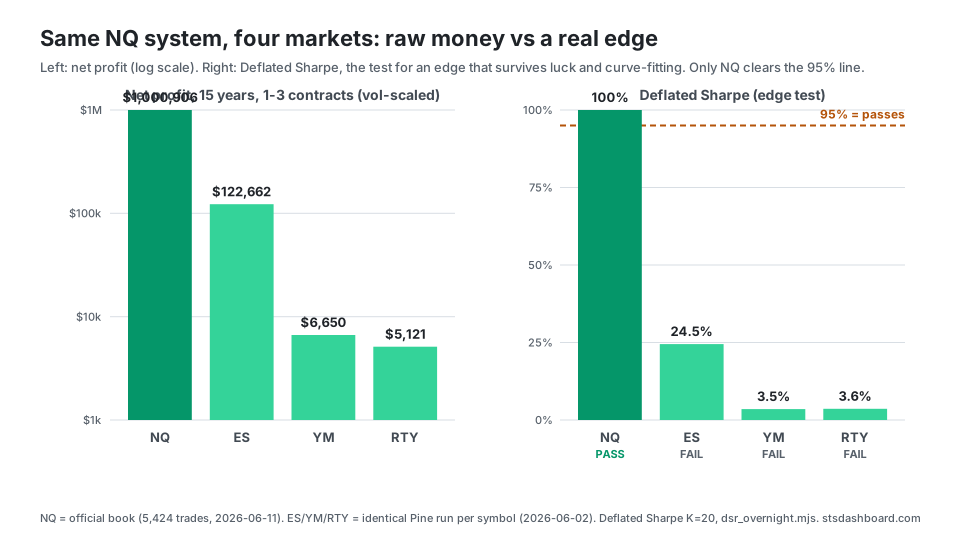
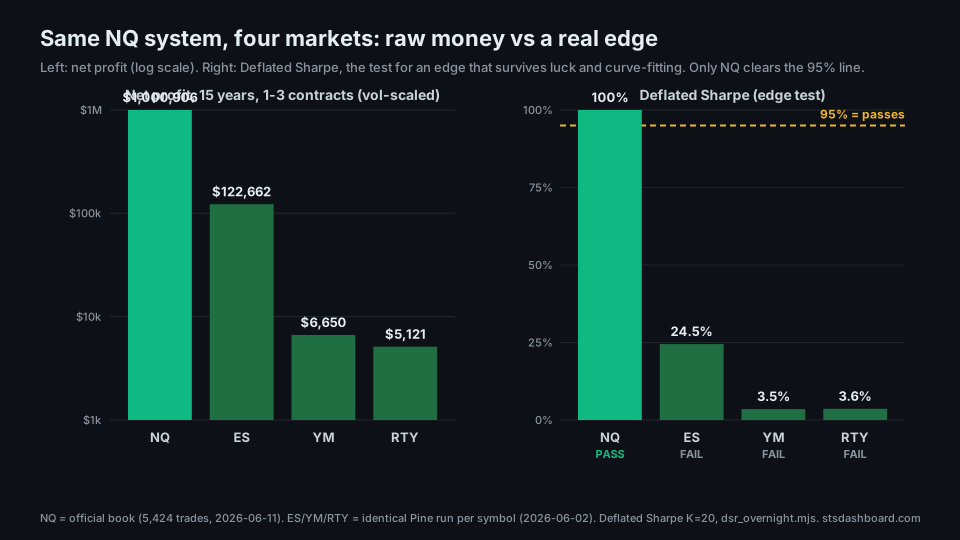
Three of four markets made money. Only one cleared the line that says the result is real. That second thing is the only one worth paying for.
What the Deflated Sharpe actually checks
The Deflated Sharpe is the strictest number in the table, so it is worth one plain paragraph.
A normal Sharpe ratio just asks: how good was the return for the risk taken. The problem is that if you test a strategy on enough markets, one of them will look good by luck alone. The Deflated Sharpe corrects for that. It asks: after accounting for the fact that we tried this on several markets, and for the wild outlier trades in the data, what is the chance this result is real and not luck.
A score above 95% means the edge survives that haircut. NQ scores about 100%. ES scores 24.5%. YM and RTY score under 4%. We ran the same test, the same way, on all four. Only NQ lived through it.
This is the same test we run before any strategy goes in our book. We did not invent it for this article. It is a standard academic method (Bailey and Lopez de Prado), and it is built to catch exactly this kind of "looks profitable, is actually noise" trap.
The drawdown that came with the "money"
There is one more reason the raw P&L lies. The small profits on ES, YM, and RTY came with risk that would have ended the account.
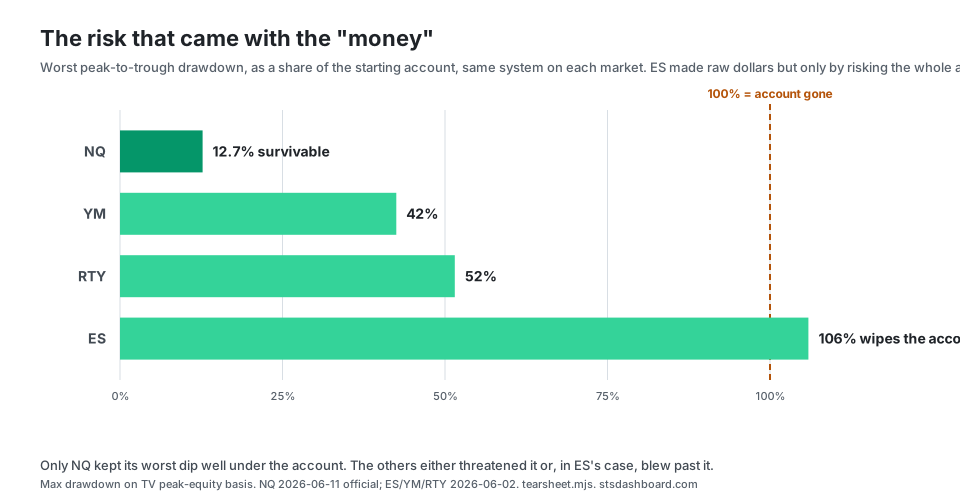
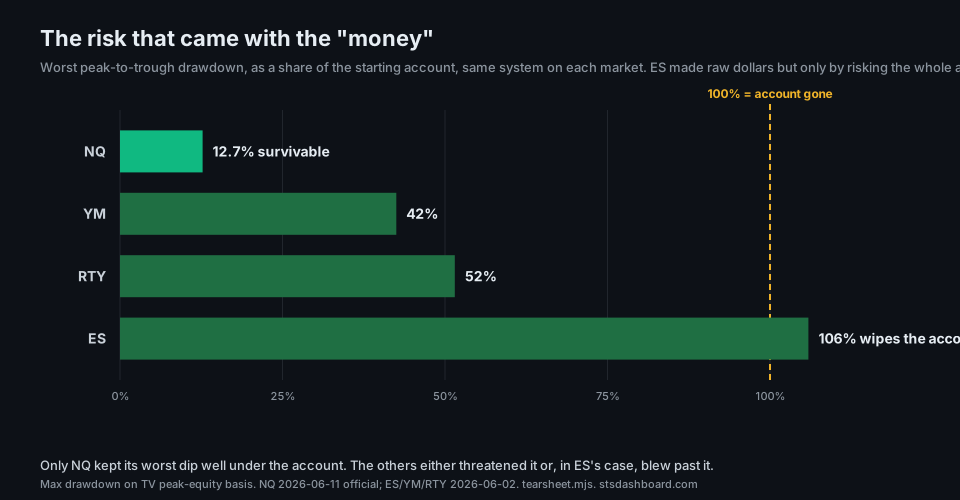
NQ's worst drawdown was 12.7% of peak equity. Survivable. You can sit through that and keep trading.
ES hit 106%. That is not a drawdown you sit through. That is a blown account. The profit ES eventually showed is a number you could never have reached, because you would have been stopped out of the game years earlier. YM at 42% and RTY at 52% are not account-enders, but they are deep holes to climb out of for almost no reward at the bottom.
So the honest read is not "the system makes a little on ES." It is "the system would have wiped the account on ES, and the leftover figure on the chart is fiction you could not have traded."
Why this is the opposite of cherry-picking
A fair question: did we just get lucky that our one chosen market is also the one that works? It is the obvious thing a skeptical trader would ask next.
We checked. We did not stop at the four index futures. We ran the same book on gold, crude oil, the euro, bitcoin, and 10-year Treasury notes too. The pattern held. A couple printed raw dollars by riding a bull market (gold, bitcoin), but every single one of them failed the edge test, the same way ES did. Treasuries were the worst. There the rules lost money on average, with a t-stat of -10.
So NQ is not one winner we picked out of a row of winners. It is the only market, out of nine we tested, where the rules produce a statistically real edge. That is the whole point of the test. A real edge usually survives at least one honest move to a new market. A curve fit does not. A curve fit is a result shaped to fit past data rather than a real edge, and it dies the moment you move it. That is what these rules did everywhere but NQ.
The edge does not live in the rules alone. It lives in how these momentum rules fit the Nasdaq's specific behavior. NQ has a bigger intraday range. It trends harder once it goes. And it pays more for the few big opening drives that carry our profit.
If you want the deeper NQ-versus-ES breakdown, we wrote a whole piece on why NQ and ES behave so differently for this system.
How we measured this
The instrument set is the four CME index futures, traded with the book's volatility-scaled sizing of one to three contracts, no compounding, $100,000 nominal starting capital. NQ is our live book, the official TradingView Intraday export from 2026-06-11 (5,424 trades). ES, YM, and RTY are the exact same six-strategy Pine, run per symbol inside TradingView over full available history and exported on 2026-06-02. NQ, ES, and YM cover about 15 years; RTY has about 9 years of TradingView history. The system stayed active on every market, taking thousands of trades each, so these are real failures, not a case of the rules sitting out.
Costs are included. The backtests carry commission and slippage on every fill, the same settings on every market.
We computed every stat two ways. The tear sheet script gives net P&L, drawdown, and the t-stat. A separate Deflated Sharpe script recomputes the edge test independently, using 20 trials as the multiple-testing count, a conservative number that covers the four index futures plus the other markets we screened. The numbers in this article are the ones those scripts produced, run fresh on the export files named above.
Two honest limits. First, the strategy keys off the 9:30 ET equity open, which is the right session for the index futures but not the natural session for assets like gold or crude, so treat the non-index results as a transfer screen, not a tuned test. Second, an earlier internal note from June used a different vintage of the NQ book and reported a slightly higher t-stat (6.43). We use the current official single-position book here, which is the same book every number on this site reconciles to, and it lands at a t-stat of 4.63 and a Deflated Sharpe near 100%. Both vintages pass clearly; we report the current one.
What would change our mind: if ES, YM, or RTY cleared a t-stat of 3 and a Deflated Sharpe of 95% on the same unchanged rules, the "NQ-specific" claim would be wrong. They do not come close.
Judge a strategy by its statistics, not its dollar total. The same rules made money on three markets and had a real edge on only one. A profit with a near-zero t-stat and a 100% drawdown is a story about luck and risk, not skill.
What to do with this
If you build or buy systems, do this one test before you trust any of them. Take the rules, clone them onto a market they were not built for, change nothing, and look at the t-stat and the Deflated Sharpe instead of the P&L. If it only works on the one market it was tuned on, and the dollars came with account-ending drawdowns, that is a curve fit, not an edge.
For us, this test is the reason the product is what it is. We do not sell a generic multi-market system, because we do not have one. We have a validated NQ specialist, and trying to stretch it across ES, YM, and RTY would only add drawdown and dilution, not diversification. You can see the six strategies and how they fit together on our strategies page, and the full performance record on the tear sheet.
If a single, statistically vetted NQ edge is what you want to trade alongside, that is exactly what the signals subscription gives you access to. One market, run the way the data says it should be run.
Disclosure. We trade this book live and sell access to the signals, so judge the data accordingly. This article is educational and is not investment advice, a recommendation, or an offer to buy or sell any security or futures contract.
Hypothetical performance disclaimer (CFTC Rule 4.41). The results described here are based on backtested and hypothetical performance. Hypothetical performance results have many inherent limitations, some of which are described below. No representation is being made that any account will or is likely to achieve profits or losses similar to those shown. In fact, there are frequently sharp differences between hypothetical performance results and the actual results subsequently achieved by any particular trading program. One of the limitations of hypothetical performance results is that they are generally prepared with the benefit of hindsight. In addition, hypothetical trading does not involve financial risk, and no hypothetical trading record can completely account for the impact of financial risk in actual trading. For example, the ability to withstand losses or to adhere to a particular trading program in spite of trading losses are material points which can also adversely affect actual trading results. There are numerous other factors related to the markets in general or to the implementation of any specific trading program which cannot be fully accounted for in the preparation of hypothetical performance results and all of which can adversely affect actual trading results.
Past performance does not indicate future results.