How to Read the NQ and ES Daily Bias: A Data Framework
If you came here for a call on where NQ or ES goes today, this is the honest version of that question. The daily bias is your lean on how a session may behave. Reading it is not about guessing which way the market goes. It is about framing the day before it starts. We do that with three objective inputs: when the day usually does its work, how big a normal day is, and where overnight already set the reference levels. In our own NQ book, those first two are stark. Two time windows hold 77% of all profit, and a normal NQ day covers about 137 points to ES's 36.
This is a framework, not a forecast. We are not going to tell you where NQ or ES is headed today. Nobody honest can. What we can hand you is the same structure we use to size up a session, so you can build your own read instead of borrowing someone else's call.
Whose trades are these (read this first)
These numbers come from our own book: six systematic NQ strategies run as one single-position portfolio. TradingView backtests, 2011 to 2026, one to three contracts scaled by volatility, commissions and slippage included, $1,000,906 net. The style is momentum and trend continuation, which means we trade with a move, not against it. It is intraday plus one overnight model. Not mean reversion, which bets a move snaps back. Not scalping.
That matters for how you read what follows. Our systems pick their entry times on purpose, so the time-of-day numbers show where our setups make money, not a free property of the market.
So take the method, not our exact figures. The three inputs below are objective and you can measure them on whatever you trade. The values you get will be your own. Nothing here is a rule about where the market has to go.
The framework: three questions, asked before the open
A daily read is just three questions answered in order. None of them asks "up or down."
1. When is the day likely to do its work? Markets do not spread their movement evenly across the clock. There are busy windows and dead windows. Knowing which is which tells you when to pay attention and when to sit on your hands.
2. How big is a normal day? Range is a ruler. If you know what an average day covers, you know whether a move is already stretched or still has room. A target that needs two average days to reach is a different bet than one inside today's normal range.
3. Where did overnight leave the reference levels? The overnight session quietly builds the levels the day session reacts to: the high, the low, and where price settled. Those are not predictions. They are just the marks the day opens around.
Answer those three and you have a frame. A frame tells you where the action probably is and how much room it has.
Here is the whole framework on one card, with what each input answers and where the number comes from.
| Input | The question it answers | What we measured (NQ book) | What you measure |
|---|---|---|---|
| When | Where in the day does movement concentrate? | 77% of profit in the 9 ET and 18 ET windows | Your own profit by entry hour |
| How big | Has the move used up a normal day's range? | NQ ~137 pts / $2,750 a day, ES ~36 pts / $1,815 | Your market's recent average daily range |
| Where | What levels did overnight already set? | Overnight high, low, and settle | Mark them before the open |
Input one: the day does its work in a few windows
Here is the first input, measured on our book. We grouped every one of our 5,424 NQ trades by the hour it was entered, then summed the profit in each hour.
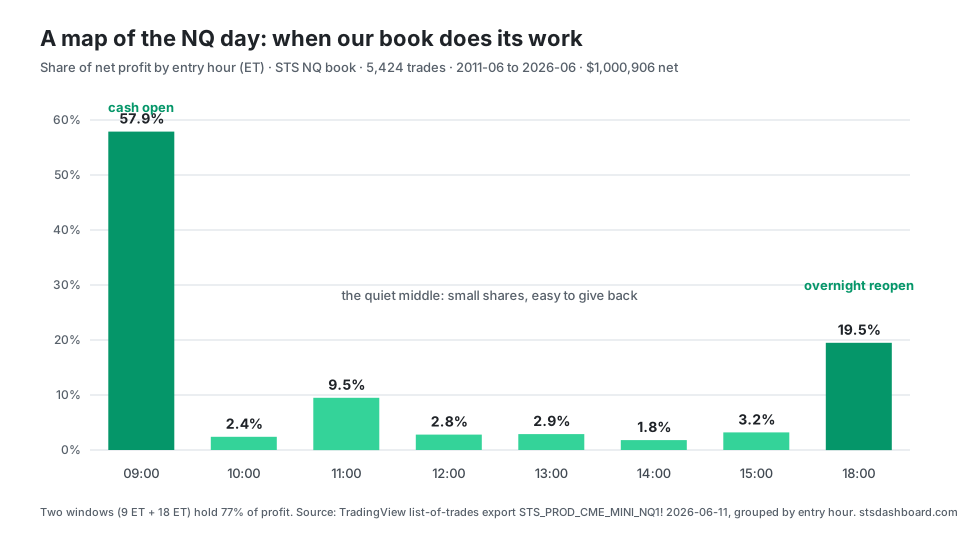
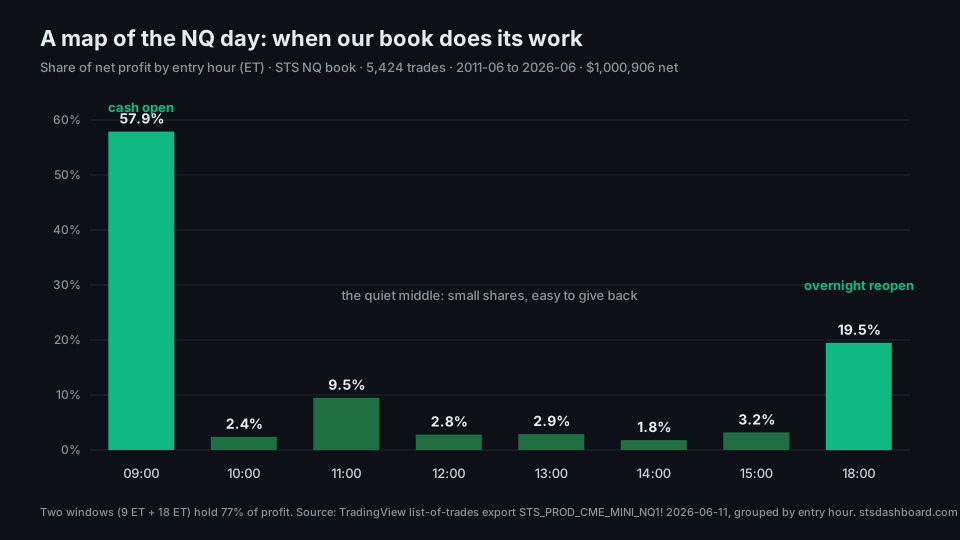
The shape is lopsided on purpose. The 9 ET hour, the 9:30 a.m. New York stock-market open, held 57.9% of all profit. The 18 ET hour, 6 p.m. ET, right after index futures reopen from their brief daily close, held another 19.5%. Add them and 77% of the profit came from two hours of the day. Everything between 10 ET and 15 ET is small.
For reading the day, the lesson is about attention, not direction. The open is when the day's character usually gets set. If a move is going to happen, the busy windows are where it tends to show up. The quiet middle is where traders most often manufacture trades out of boredom and give back what the open earned. We dug into the full hour-by-hour and weekday breakdown, including why the best hour has our lowest win rate, in our piece on the best time to trade NQ futures.
A discretionary trader cannot copy our 57.9%. But the question transfers cleanly: when does your market, on your setups, actually pay you? Run the same grouping on your own fills and you will get your own map. Most traders find it is far more lopsided than they expected.
Input two: range is your ruler
The second input is how big a normal day is, the distance from the day's high to its low. This is where NQ and ES split, and where reading them as a pair gets useful.
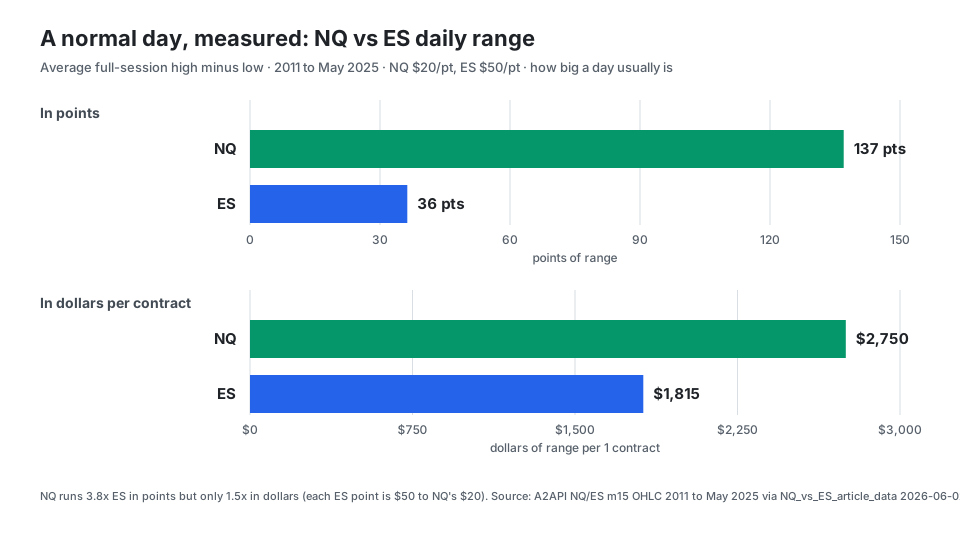
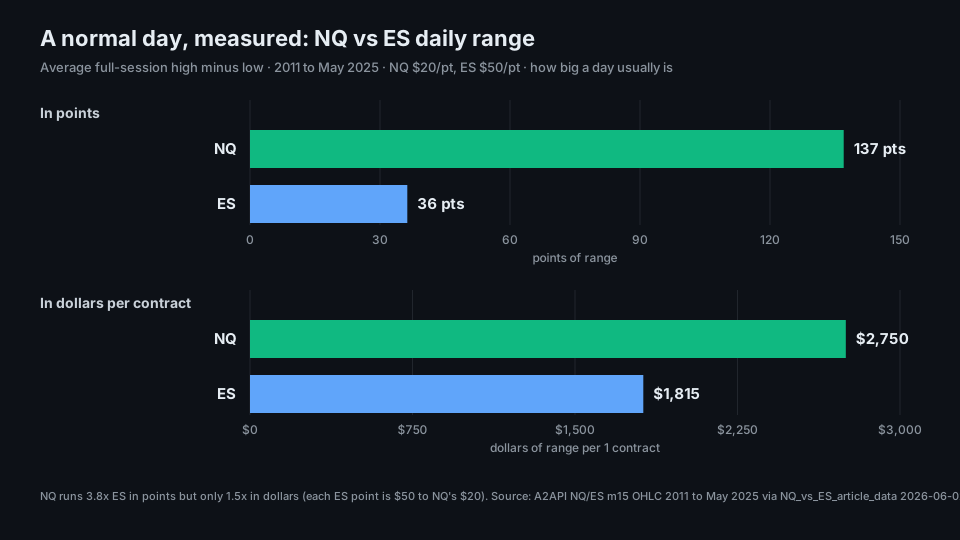
Across 2011 to May 2025, NQ's average daily range was about 137 points, ES's about 36. So NQ looks nearly 3.8 times wilder. But points are not money. Each NQ point is worth $20 and each ES point is worth $50. In dollars, the average NQ day was about $2,750 of range against ES's $1,815. That is only about 1.5 times.
Why this matters for a daily read: range tells you whether a level is reachable. If NQ has already traveled 130 points by midday, it has covered an average day's worth and the easy room may be gone. If it has covered 40, there is likely more in the tank. You are not predicting the close. You are checking the odometer against the average trip.
One caution on the ruler. Range is not fixed. It stretches and shrinks with volatility, and a lot. In calm 2017, NQ's average day was about 48 points. In wild 2022 it was about 335. So the "normal day" you measure has to be the recent normal, not a 15-year average pinned to a wall. We cover how the two markets move together, and why that 0.93 correlation actually tightens when things get rough, in NQ vs ES futures.
Input three: overnight sets the reference levels
The third input is the cheapest to check and the easiest to skip. Before the cash session opens, the overnight market has already drawn the day's first reference points: the overnight high, the overnight low, and where price has been settling, meaning where it closed out the prior session.
These are not signals. They are landmarks. The day session tends to react around them, whether by breaking through or turning back. Either reaction is information. A break of the overnight high on heavy participation says something different than a quiet drift back into the overnight range.
We do not publish a level-by-level overnight model, and we are not going to pretend one number is a forecast. But the connection to input one is direct. Remember that our 18 ET reopen window held 19.5% of profit. The overnight session is not dead time. It builds the structure the morning then trades against. If you only ever look at the chart after the cash open, you are reading the day with the first chapter torn out.
For a discretionary trader, this is the most portable piece of the whole framework. You do not need our systems to mark the overnight high and low before you start. It takes thirty seconds and it gives the day a frame.
A daily read is a frame, not a forecast. Answer three objective questions before the open: when does the day usually move, how big is a normal day right now, and where did overnight leave the high, low, and settle. That tells you where to look and how much room there is. It does not tell you which way to go, and any source that claims it does is selling certainty that markets do not offer.
Putting the three together
The inputs are stronger as a set than alone, read in order against the overnight high, low, and settle.
Notice what is missing. There is no step that says "therefore buy" or "therefore sell." The frame narrows where and how much. The market supplies the which way, in its own time, and you respond to what it actually does. That is the honest version of reading a daily bias. The dishonest version skips straight to a direction and dresses it up as analysis.
How we measured this
The time-of-day numbers come from the TradingView list-of-trades export of our live six-strategy NQ book, ticker CME_MINI_NQ1!, dated 2026-06-11. That is 5,424 trades from 2011-06-16 through the 2026-06-11 export (the last trade in the file closed 2026-06-08), $100,000 starting capital, no compounding, one to three contracts scaled by volatility, with commissions and slippage included. We grouped each trade by its entry hour in exchange time (ET), summed net P&L per hour, and divided by total net P&L for the share. Those share figures hold no matter the contract size, because they use actual net dollars. Anyone with the same export gets the same map.
The range numbers come from 15-minute NQ and ES price data, 2011 through May 2025. For each session we took the full high minus low, averaged across sessions, then multiplied by the point value ($20 for NQ, $50 for ES). The correlation of 0.93 is close-to-close daily returns across 4,471 sessions over the same window.
The limits, stated plainly. The profit map is a property of our momentum systems, not the market itself. A different style produces a different map. The range numbers stop at May 2025 because that is where our price file ends, while the trade data runs to 2026, so we keep those two windows separate and label them. And the overnight-levels input is a structural observation, not a tested edge with a number attached. We are not publishing a level-by-level system. All of this is hypothetical backtest performance plus live tracking. Past performance does not indicate future results.
What to do with this
Build your own frame, do not buy a call. Before your next NQ or ES session, do three small things. Measure where your own trades have actually made money by hour, so you know your real busy windows; most trading platforms let you export a trade history you can sort by entry time. Write down the recent average daily range, in dollars, so you have a ruler that fits the current market and not a calm year from the past. And mark the overnight high and low before the open, so the day starts with reference points instead of a blank chart.
That is the whole method. It will not tell you which way to trade, and you should be wary of anything that claims to. What it does is point your attention at the part of the day that matters and tell you how much room is left, which is most of what a daily read is for.
If you would rather have the read made systematically, that is what we sell. The same six systems measured here trade the busy windows for you and send the entries as real-time signals. The full performance, drawdowns and all, is on the strategy page and the tear sheet. Plans are on the pricing page.
We trade this book live and sell access to the signals, so judge the data accordingly. This article is educational and is not investment advice. Futures trading involves substantial risk of loss and is not suitable for every investor.
Hypothetical performance disclaimer (CFTC Rule 4.41): hypothetical or simulated performance results have certain limitations. Unlike an actual performance record, simulated results do not represent actual trading. Also, since the trades have not been executed, the results may have under- or over-compensated for the impact, if any, of certain market factors, such as lack of liquidity. Simulated trading programs in general are also subject to the fact that they are designed with the benefit of hindsight. No representation is being made that any account will or is likely to achieve profit or losses similar to those shown. Past performance does not indicate future results.