Why profitable traders fail prop firm combines: the trailing drawdown math
We ran our NQ strategy through a Monte-Carlo simulation of TopStep's $50k Trading Combine, at one micro per signal. The strategy made $1,000,906 net across 5,424 trades over 15 years. It still hit the $2,000 trailing Maximum Loss Limit before reaching the profit target in 45% of orderings (20,000 reshuffles).
Read that again. A strategy with 15 winning years out of 16, whose only losing year was -$378, fails the cheapest combine almost half the time. The reason is arithmetic, not skill. The trailing floor is not testing whether you make money. It is testing whether your losing streaks ever get bigger than the room they give you. Those are two different things.
Whose trades are these: every number here comes from our own book of six systematic NQ strategies, run as one single-position portfolio in TradingView backtests, 2011 to 2026, at 1 to 3 volatility-scaled contracts (modeled at one micro for the combine). The style is momentum and trend continuation, intraday plus one overnight model, not mean reversion. That matters, because a momentum book has long losing streaks between big winners. Your strategy has its own drawdown pattern, and the odds below scale with it. What transfers to any trader, including a discretionary one, is the method: Monte-Carlo your own trade history, read off the 95th-percentile interim drawdown per contract, and size that number against the trailing room. Our exact percentages do not transfer.
The trailing floor follows your best moment, not your starting balance
TopStep's Maximum Loss Limit (rules as of June 2026, per the TopStep help center) works like this on the $50k Trading Combine. The account starts at $50,000. The MLL starts $2,000 below, at $48,000. The floor rises with your end-of-day balance and never comes back down. It is checked in real time using both realized and unrealized P&L, so an intraday touch counts. Once a day closes with your balance at $52,000 or higher, the floor locks at $50,000 for good. The $100k and $150k Combines work the same way, with $3,000 and $4,500 of room.
Here is a four-day walk-through of a trader doing well by any normal definition:
| Day | Day P&L | End-of-day balance | Floor after close | Room left |
|---|---|---|---|---|
| Start | $50,000 | $48,000 | $2,000 | |
| 1 | +$1,200 | $51,200 | $49,200 | $2,000 |
| 2 | +$1,000 | $52,200 | $50,000 (locked) | $2,200 |
| 3 | -$1,300 | $50,900 | $50,000 | $900 |
| 4 | dips -$950 intraday | violation at $49,950 |
On day 4 the open position goes $950 against him before recovering. He would have closed at $50,400, up $400 on the account, and at his day-2 peak he was 73% of the way to the $3,000 target. None of that matters. The balance touched $49,950. That is below the locked $50,000 floor, so the account is liquidated and ineligible. He won $2,200 across his two green days. He never lost more than $1,300 in a session. He still failed.
The floor turns your drawdowns into a blow-up probability
That walk-through is the whole insight in miniature. A trailing floor only looks at one thing about your strategy: how big its dips from each new equity peak get. Then it asks one question. How often does a dip get bigger than the gap? Expectancy, win rate, and annual returns never enter the math.
Our numbers make the mismatch concrete. A Monte-Carlo on the real trade list (10,000 reshuffles, per our 2026-06-01 safety-limit study) puts the forward maximum drawdown for one NQ mini at a median of about $52,000 and a 95th percentile near $81,000. Divide by ten for one micro: median roughly $5,200, bad-but-normal roughly $8,100. Now line those up against the floors: $2,000 of room on the $50k Combine, $4,500 on the $150k. Even at one micro per signal, a completely normal drawdown for this strategy is two to four times the room the combine gives you. Being profitable does not help. The dips do not fit through the gap.
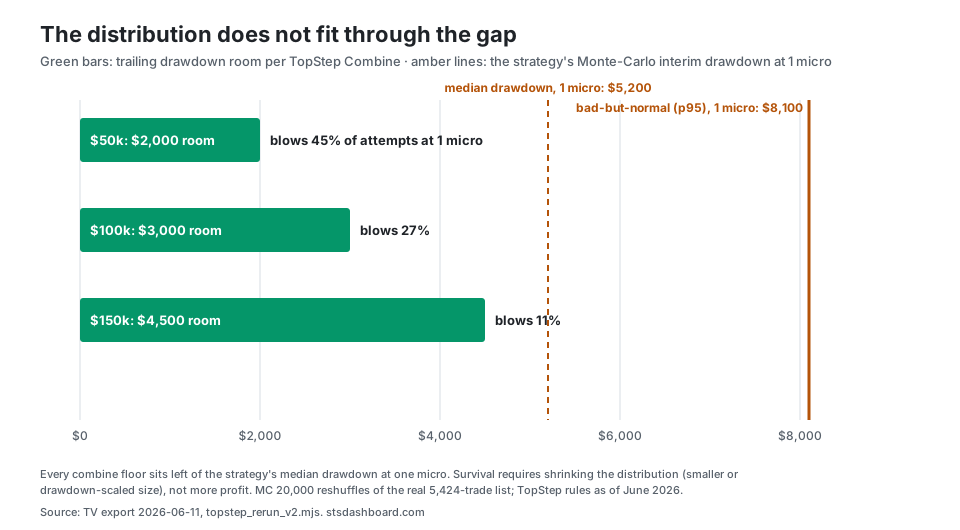
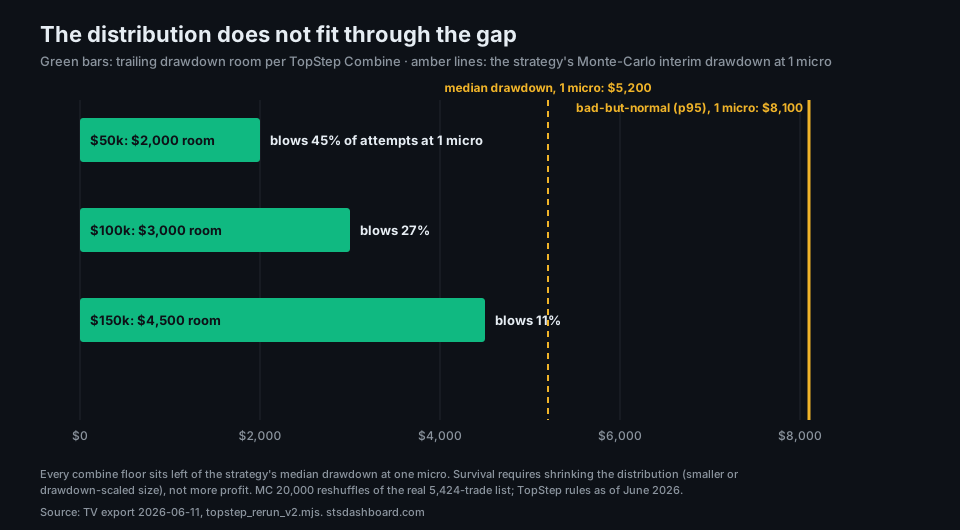
The only reason any attempt survives is that a combine is short. You just have to reach the profit target before a bad stretch shows up. That is why the simulated failure rate is 45% and not near-certain. It is also why traders with real positive expectancy fail combines so often. They are not failing a profit test. They are failing a variance test they never sized for.
A drawdown-scaling overlay cut the $50k blow-up rate from 45% to 27%
We tested execution variants against combine rules using trade-shuffle Monte-Carlo (20,000 orderings per cell) on the full export. Each simulated attempt ends the moment it reaches the profit target (pass) or touches the trailing floor (blow), the same way a real combine ends.
One change mattered: drawdown scaling. Cut position size to 0.66x once your dip from the account's equity peak passes 44% of the trailing room. Cut to 0.33x beyond 67% of the room. Never go below 0.33x. The multiplier steps back up on its own as equity recovers, because it only depends on the current distance from peak. The simulation applies exactly that rule. Fresh re-run on the 2026-06-11 official export:
| Account | Logic | P(blow before target) | P(pass) |
|---|---|---|---|
| $50k | Fixed 1 micro per signal | 45% | 55% |
| $50k | Drawdown-scaled | 27% | 73% |
| $150k | Fixed 1 micro per signal | 11% | 89% |
| $150k | Drawdown-scaled | under 2% | 98% |
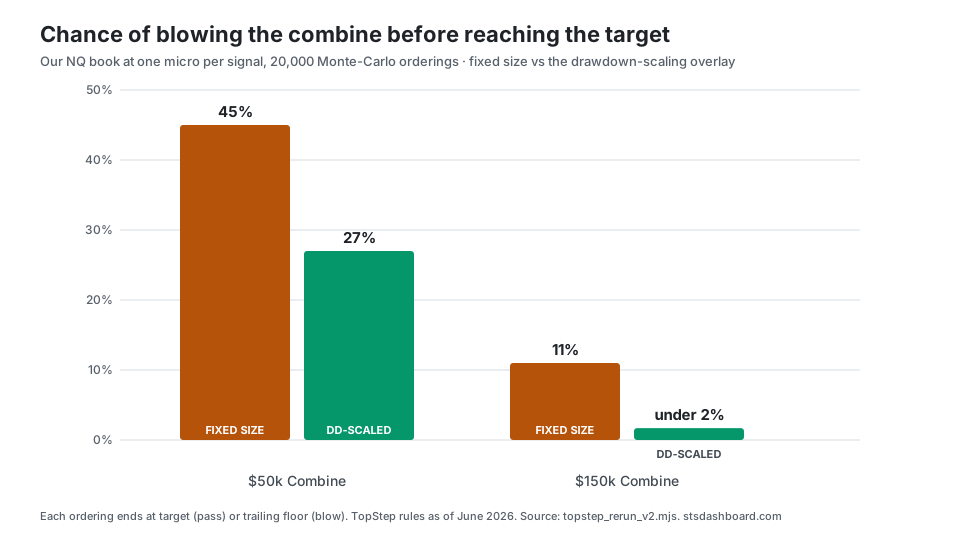
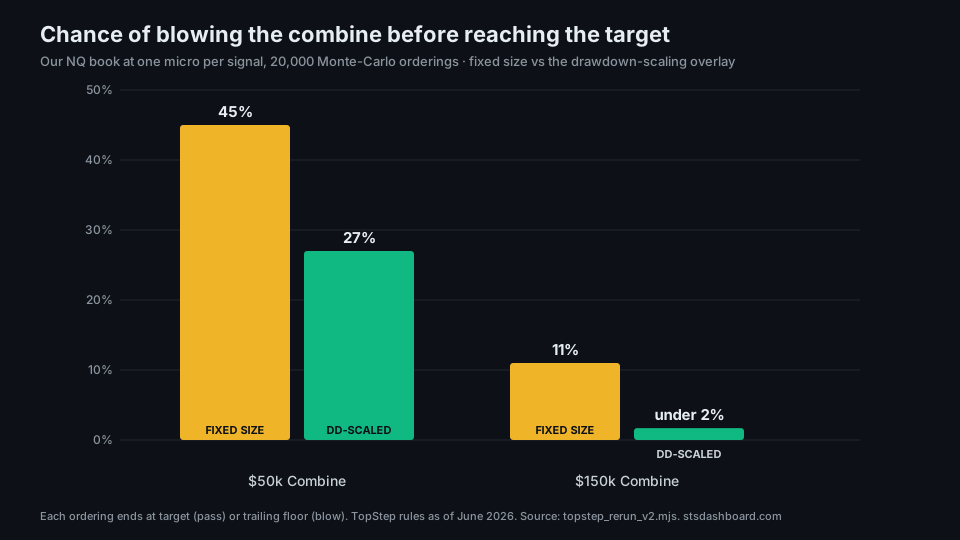
A combine is a variance test, not a profit test. Size so your strategy's bad-but-normal drawdown (the Monte-Carlo 95th percentile per contract) fits inside the trailing room, and shrink size when you are below your peak.
Every row sums to 100%. The overlay never cuts size to zero, so no simulated attempt stalls. Each ordering either passes or blows.
The overlay is not free. It trades speed for survival. The median $50k pass stretches from 89 trades (about 3 months at our pace) to 140 trades (about 5 months), because you trade smaller exactly when the account is below its peak. On our own uncapped capital we found that trade-off unattractive. But a combine is not uncapped capital. The goal is survival. The overlay cuts the one event that ends the attempt by roughly half on the $50k and by a factor of five on the $150k, while raising the pass rate.
The cost math follows. We modeled expected total cost including blow-up retries: monthly fee times expected months until a pass, plus the $149 activation. Fees per TopStep's pricing page: $49, $99, and $199 per month for the $50k, $100k, and $150k. The $50k comes out around $215 to $230 all-in at its cheapest sizing cells, with or without the overlay. That is the cheapest funded path in our grid. The smallest account is also the easiest per dollar: its $3,000 target is 1.5x its $2,000 of room, versus 2.0x on the larger sizes.
One result from the cost grid surprised us, so we will report it instead of burying it. In pure fee terms, aggressive sizing is not punished much. Oversized attempts blow often, but they blow fast. So the retry is cheap, and expected cost stays in a narrow band across sizes. We still do not recommend trading that way, for two reasons the model cannot see. The grid pro-rates fees by days while TopStep bills by the month, which flatters fast failures. And the Daily Loss Limit and consistency rule, which a trade shuffle cannot model, both bite hardest on large size. What sizing reliably controls in our simulation is the per-attempt failure rate, not the fee bill.
What to copy tomorrow: size to the floor, not to the target
The practical rule is one line. Find your strategy's bad-but-normal drawdown per contract: the 95th percentile of a Monte-Carlo on your own trade history. Then size so that number fits inside the trailing room, with margin to spare. For us that meant micros, one tenth of the backtested mini size, plus the scaling overlay, because one micro's $8,100 p95 drawdown already exceeds every combine floor on its own. If your p95 per contract is bigger than the room, every attempt is a bet against variance. Only smaller size or fewer trades changes the odds.
Trading smaller feels slow. In a combine, slow is mostly what you are buying: a lower chance that any single attempt ends in a liquidation before the target. The fee math is more forgiving of failure than we expected. But fees are not the only cost of a blown account, and the rules our shuffle cannot model all punish size. Trade small is still our verdict, held with moderate confidence, for survival rather than the fee bill.
How we measured this
Instrument: NQ (CME E-mini Nasdaq-100), modeled at micro scale as mini dollars divided by 10. Data: our production strategy's full TradingView deep-backtest trade list, official export STS_PROD_CME_MINI_NQ1!_2026-06-11.csv, 5,424 trades, June 2011 to June 2026, commissions and slippage included in the backtest. Combine simulation: trade-shuffle Monte-Carlo, 20,000 orderings per configuration (script topstep_rerun_v2.mjs), against TopStep's published parameters as of June 2026: trailing MLL $2,000/$3,000/$4,500 (help center) and profit targets $3,000/$6,000/$9,000 (stated in the help center's consistency target article). Each simulated attempt ends at the first of: profit target reached (pass) or floor touched (blow). Every ordering resolves to exactly one of those two outcomes. The drawdown-scaling overlay in the simulation is the same rule described above: 1x size while the dip from peak is under 44% of the trailing room, 0.66x to 67%, 0.33x beyond, recovering automatically with equity. Our simulated floor trails the intraday favorable excursion of each trade. That is stricter than TopStep's end-of-day trailing, so our blow probabilities are conservative. The consistency target and Daily Loss Limit are not modeled in the shuffle, since reordering destroys day structure. With 20,000 iterations the Monte-Carlo standard error on the headline probabilities is about 0.4 points, so we quote whole percentages. What would falsify the claim: a trade distribution with much smaller peak-relative dips than ours, which would compress every probability in the table.
Where this analysis stops
These are our strategy's trades. Your strategy has its own drawdown pattern, and everything above scales with it. The simulations are hypothetical reorderings of historical trades, not live combine results. Shuffling also understates loss clustering if your losses arrive in regimes rather than independently. The cost model pro-rates monthly fees by calendar days, which understates the real cost of short failed attempts billed by the month. Prop firm rules change too. TopStep's parameters here are cited as of June 2026 and should be re-checked at the source before you act on them. We have no affiliation with TopStep. We used their rules because they publish them clearly, and the math applies to any firm with a trailing floor.
The full distribution work behind these numbers lives in our strategy research and the live-tracked tear sheet. If you want the signals that generated the trade list we tested, that is the one thing we sell.
STS Research. Educational content, not investment advice. We trade this strategy live and sell access to its signals; judge the data accordingly. We have no relationship with TopStep or any prop firm.
CFTC Rule 4.41: Hypothetical or simulated performance results have certain limitations. Unlike an actual performance record, simulated results do not represent actual trading. Also, since the trades have not been executed, the results may have under- or over-compensated for the impact, if any, of certain market factors, such as lack of liquidity. Simulated trading programs in general are also subject to the fact that they are designed with the benefit of hindsight. No representation is being made that any account will or is likely to achieve profit or losses similar to those shown.
Past performance is not indicative of future results.